In this article, I’ve compiled everything you need to know about money and currency in Serbia—what it’s called, the exchange rate, where to exchange money, what currency to bring to Serbia (2026), what people use to pay in Serbia, whether you can pay by card everywhere, whether you need cash, and how much money you can bring into and out of the country. The post contains a lot of useful information based on my personal experience for those traveling to Serbia for the first time. I’ve covered how much money you’ll need for a vacation in Serbia in a separate article →
- What currency is used in Serbia: what the Serbian currency looks like and is called
- Today’s exchange rate of the Serbian currency against the ruble, euro, and dollar
- What’s better to take to Serbia—dollars or euros?
- How much cash can you bring in and take out?
- What is the currency used in Serbia?
- Where is the best place to exchange money in Serbia?
- Can you pay by card, and which cards are accepted in Serbia?
- Cash vs. Cards in Serbia: Do you need cash in 2026?
- ATMs in Serbia—How to Withdraw Money from Your Card
- FAQ
What currency is used in Serbia: what the Serbian currency looks like and is called
Serbia has its own national currency, called the Serbian dinar. In stores, cafes, restaurants, and gas stations, prices are listed in dinars or RSD.
RSD is the international currency code for the Serbian dinar.
Money in Serbia comes in two forms:
- paper bills in denominations of 10, 20, 50, 100, 200, 500, 1,000, 2,000, and 5,000 RSD
- coins in denominations of 1, 2, 5, 10, and 20 RSD
Here are photos of what Serbian currency looks like:


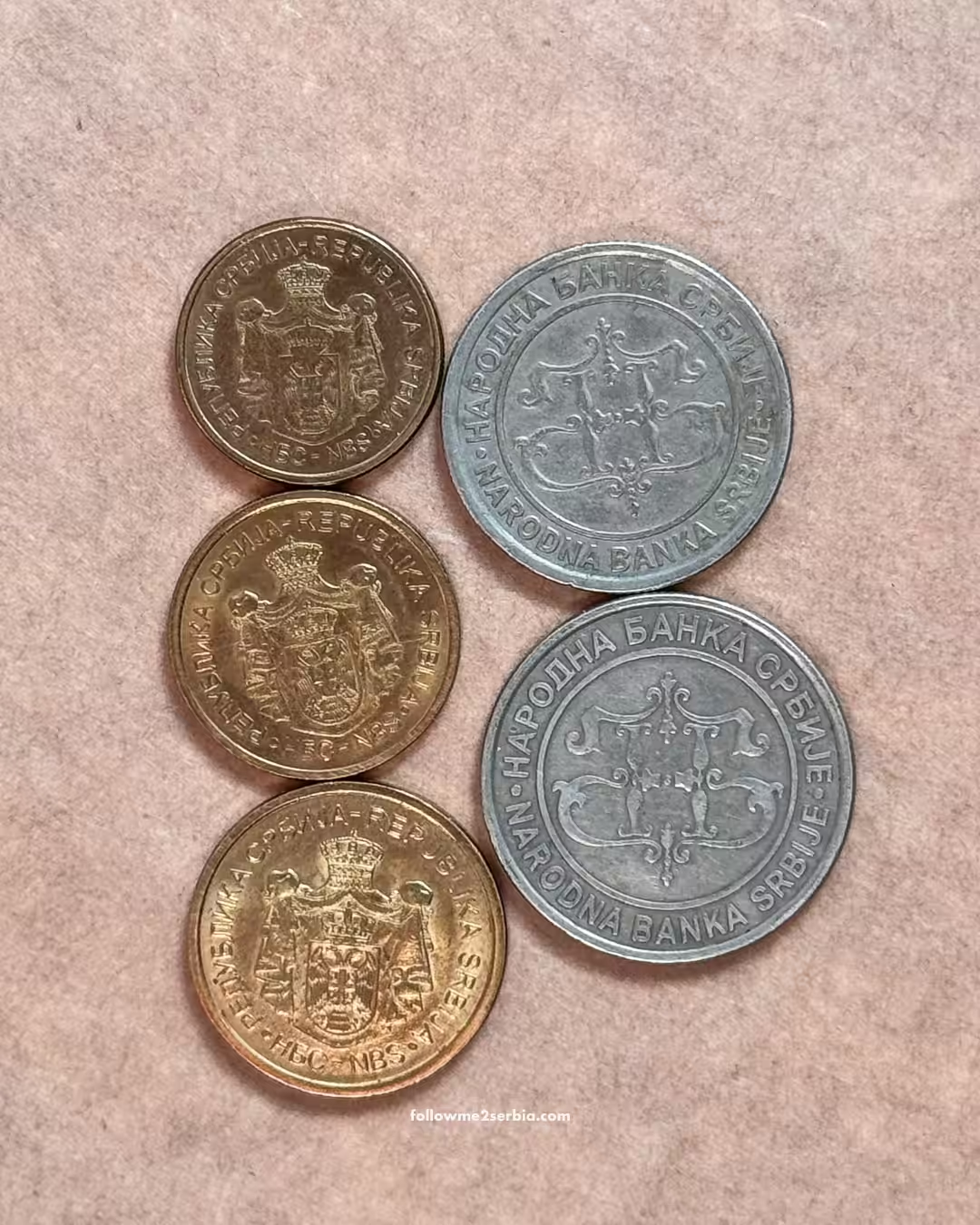

You can plan a tour of Serbia’s sights based on its coins, and learn about the country’s history through its banknotes. For example, the 20-dinar coin features the Church of St. Sava—not only the main Orthodox church in Belgrade and Serbia, but also in the Balkans. I wrote more about it in my article on Belgrade’s landmarks.
If you’re interested in Serbian coins and banknotes from a numismatic perspective, you can read about the series and years of issue on this Wikipedia page.
Today’s exchange rate of the Serbian currency against the ruble, euro, and dollar
Below are the current exchange rates in Serbia. The information is updated daily and sourced from Open Exchange Rate.
Today’s euro exchange rate in Serbia: 1€ = 117.43 RSD.
The current exchange rates of the Serbian currency against other currencies are as follows:
| 1 EUR (euro) | 117.43 RSD |
| 1 USD (US dollar) | 104.65 RSD |
| 1 GBP (British pound) | 140.17 RSD |
| 1 AUD (Australian dollar) | 73.43 RSD |
| 1 CAD (Canadian dollar) | 74.64 RSD |
| 1 CHF (Swiss franc) | 127.56 RSD |
What’s better to take to Serbia—dollars or euros?

At currency exchange offices (Serbian exchange bureaus), the two most popular currencies are the euro (EUR) and the dollar (USD). However, it’s still better to travel to Serbia with euros.
How much cash can you bring in and take out?
A very important point is how much cash you can bring into Serbia. If you have less than €10,000 in cash per person, you can bring the money in without declaring it. If you have more, you must declare the amount. At the airport, you’ll need to go through the red channel. When crossing the border by land, you must also declare any foreign currency or securities worth more than 10,000 euros.
What happens if you don’t declare the money you’re bringing in? Customs may confiscate it. Neighboring Montenegro has very strict rules regarding this, and every year, tourists have all their cash confiscated if the total exceeds €10,000.
You can take currency out of Serbia in an amount equivalent to up to 10,000 euros per person. This amount includes dinars being taken out of the country.
What is the currency used in Serbia?
All goods and services in Serbia are paid for in dinars, the Serbian national currency.
In tourist areas, it is sometimes possible to pay in euros. For example, in my experience, if you rent private accommodations, the hosts will gladly accept payment in euros.
Prices for apartment rentals, car rentals, or the purchase/sale of real estate and cars are listed in euros. However, all payments are made in the national currency.
Where is the best place to exchange money in Serbia?
You can exchange currency at bank branches or at exchange offices (menjacnica). A menjacnica is a licensed currency exchange office. In Belgrade, they’re on almost every corner, but the exchange rates vary. In my experience, the rates at small exchange booths in markets are always poor. Shopping malls always have exchange booths, and sometimes they even offer good rates. By the way, there’s still no reliable Telegram bot or website with accurate rates for all exchange booths. Often, the rates listed in the bots I’ve tested don’t match reality.
Here’s what currency exchange booths look like on the streets of Belgrade, and they’re roughly the same in other cities in Serbia:


Airports and train stations have currency exchange machines. They look like ATMs, but usually have “menjacnica” written on them in large letters. For example, the photo shows automatic exchange machines in the arrivals hall at Belgrade Airport:


In Serbia, as in all other countries, the rule applies: the exchange rate at airports and train stations is always unfavorable. Therefore, exchange as little as possible there.
What you need to know about Serbian currency exchange offices and banks:
- You don’t need a passport to exchange currency for dinars.
- Most currency exchange offices and banks are open until 5 p.m.
- Banks are closed on Saturdays and Sundays.
- Only some currency exchange offices are open 7 days a week.
- On national and religious holidays, most currency exchange offices and all banks are closed.
Can you pay by card, and which cards are accepted in Serbia?
In Serbia’s major cities, you can pay with a Visa or MasterCard almost everywhere. Serbs pay with cash at markets and in small villages where there may be no internet access.
An important point about paying with cards in Serbia. If you’re paying with a card and the terminal offers you the choice to “pay in dinars (RSD) or euros (EUR),” my experience shows that it’s more cost-effective to pay in the Serbian currency. Let me explain why using my own example.
I have a Visa card in euros.
- If I choose to pay in RSD, the RSD to EUR conversion will be done at the Visa exchange rate plus a 2% bank fee, but without any additional conversions.
- If I choose to pay in EUR, the price will be converted from RSD to EUR at the bank’s exchange rate, which is already unfavorable on its own—and even worse on weekends and outside business hours. Plus, this rate can change within a couple of days.
From my own experience, I’ve realized that I lose 2–5 euros every time I pay with a euro card, since the dinar is converted to euros. Although, on the surface, it would seem like the opposite—it should actually be more cost-effective.
I hope this wasn’t too complicated. You can use the official Visa calculator (here’s the link) to calculate the exact amount after conversion.
Cash vs. Cards in Serbia: Do you need cash in 2026?
You’ll need cash in next situations:
- to leave a tip at a café or restaurant;
- to make a donation at a church;
- to pay for a taxi you hail on the street, rather than one ordered through an app;
- to buy something on the street, at a local market, at festival or night market (noćni bazar in Belgrade or Novi Sad). For example, mulled wine or roasted chestnuts on the street, or a souvenir at an interesting sight;
- to buy wine at small wine cellars—for example, I bought wine at a wine cellar in Sremski Karlovci, and there simply wasn’t a signal for the cash register to work;
- if you plan to travel through Serbian villages and small towns. It’s not always possible to pay by card everywhere, simply because there’s no internet connection. For example, at the iconic “Skitulko” ski café on Kopaonik (2026), you can still only pay with cash.


ATMs in Serbia—How to Withdraw Money from Your Card
ATMs in Serbia dispense money in dinars. I’ve seen that some locals withdraw money in euros (OTP Bank, Intesa), but only from cards issued by local banks. Personally, I wasn’t able to withdraw and receive cash from an ATM in a foreign currency using a card not issued in Serbia.
Not all ATMs support UnionPay cards. The ATM must display the UnionPay logo and text to indicate that it supports this system. Here is a list of banks whose ATMs definitely allow you to withdraw money using a UnionPay card:
- Banka Poštanska štedionica – blue bank
- Banca Intesa — green bank
- OTP banka – light green bank
- NLB Komercijalna banka – purple-blue bank
I hope I didn’t miss anything. If you still have questions, feel free to ask them in the comments! Also, please share the link to the Serbia travel guide at followme2serbia.com with your friends and on social media. This will really help the project grow. Thank you!