Belgrade has more than 40 museums and galleries, and they are also one of the best indoor things to do in Belgrade when it rains or gets too cold. I’ve selected the best museums in Belgrade and explain below why they’re worth visiting and what makes each one unique. I decided not to include locations like the Museum of Illusions and the Chocolate Museum, which are international franchises and look exactly the same whether in Belgrade, Vienna, or Dubai. The result is a list of the top 18 museums in Belgrade that are worth seeing first, ranging from classic museums to unusual ones and even dark tourism sites.
← Part 1 of the Belgrade Travel Guide | Part 2: Belgrade Attractions | Part 3: List of the City’s Best Museums
A Note for Tourists: How to Visit Belgrade’s Museums for Free and Other Insider Tips
I’ve lived in Belgrade for many years and have picked up various insider tips that locals use but tourists don’t know about. Here are the ones that will come in handy when visiting the museums of Serbia’s capital:
- On the first Wednesday of every month, admission to the Museum of Contemporary Art (MSUB) is free.
- On the last Saturday of every month, admission is free to museums that are part of the Belgrade City Museums. These include Princess Ljubica’s Palace, the “Belo Brdo” archaeological site in Vinča, the Banica Concentration Camp Museum, the Paja Jovanović Museum, the Ivo Andrić Museum, and other locations.
- Belgrade has its own tourist city pass, the Belgrade e-pass, which allows you to visit attractions and museums for free or at a discount. You can purchase it online via this link →
List of the Best Museums in Belgrade—Places You Should Definitely Visit
In this selection of museums, you’ll find a wide variety of places—from the classic museums that all guidebooks and tour guides mention first, to unexpected locations such as Tito’s Blue Train. To make this guide as helpful as possible, I’ve included information on whether or not it’s worth visiting Kid-friendly, as well as the museums’ Instagram accounts so you can check their current schedule and see if they’re open at all.
What You Need to Know Before Visiting Museums in Belgrade:
- Almost all major museums in the capital have information signs with English translations, and some offer audio guides.
- Most state-run museums are closed on Mondays. Likewise, most museums are closed on public holidays. Be sure to check the opening hours on the official websites before your visit.
- In most Belgrade museums, you can take a guided tour in English. Exhibitions are also fully translated into English.
1. National Museum of Serbia (Narodni muzej)
On the map | Entrance fee | @narodnimuzejsrbije
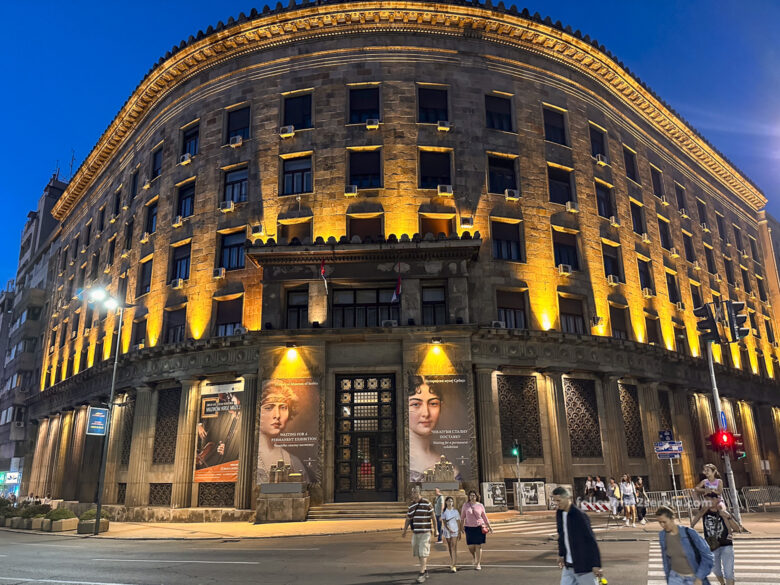
The National Museum of Serbia is the country’s main and largest museum, founded as far back as 1844. It is located right on Republic Square (Trg Republike). It houses a vast collection: from pre-Columbian artifacts and Roman relics to masterpieces by Picasso, Monet, Renoir, and the great Yugoslav artists. Here you can see a golden sarcophagus, the mummy of an Egyptian priest, and the 362-page Miroslav Gospel manuscript, which is listed on UNESCO’s “Memory of the World” Register.
Admission: 600 RSD for adults, but if you visit on a Sunday, you can explore the permanent exhibition completely free of charge.
Kid-friendly: Best suited for schoolchildren (ages 7–8 and up) and teenagers. Younger children might get bored in a traditional art gallery.

2. Nikola Tesla Museum (Muzej Nikole Tesle)
On the map | Entrance fee | @teslamuzej
 The Nikola Tesla Museum is Belgrade’s most popular and most-visited museum, dedicated to the brilliant inventor. The museum is located in a beautiful mansion in Vračar and houses the scientist’s personal belongings, his blueprints, and even an urn containing his ashes. The museum’s main attraction is its interactive tours, where guides activate real Tesla coils, and fluorescent lamps light up on their own in visitors’ hands.
What you need to know before visiting the Nikola Tesla Museum:
- You can only access the exhibition halls as part of an organized tour (in English or Serbian), which depart strictly on schedule (usually every hour). The tour schedule can be found on the official website. There is also a form there to book your visit.
- The museum’s official website states that tickets at the museum ticket office can be purchased strictly in cash (Serbian dinars); the museum does not accept credit cards or other currencies (information as of late 2026).
Tip: Since this is the city’s most popular museum and the mansion’s interior is quite compact, there are always huge lines of tourists forming on the street in front of the entrance. I recommend booking your visit using the form on the official website (link provided above) or planning your visit as part of a city sightseeing tour, where the guide will book a ticket for you. Even if you arrive 20–30 minutes before the tour starts, there’s no guarantee you’ll get into the museum, especially on weekends.
📌 Belgrade sightseeing tour including a visit to the Nikola Tesla Museum with English-speaking guide — view the description and select your dates →
Family-friendly: Definitely yes! The interactive lightning show delights both young children and teenagers.
Near the museum (at the corner of Krunska and Prota Mateja streets) is the Tesla Fountain, which many tourists miss. What makes it special is that it’s the first and only fountain in the world built according to Tesla’s original 1913 patent! The scientist designed it for the Tiffany jewelry house in New York. A distinctive feature of the design is a powerful pump that lifts a large volume of water so that it glides through the air in a single, smooth stream, then spectacularly cascades onto the base.
3. Museum of the History of Yugoslavia and the House of Flowers (Muzej Jugoslavije)
On the map | Entrance fee | @muzej_jugoslavije
The Tito Museum, or the Museum of the History of Yugoslavia, is a large-scale memorial complex in the prestigious Dedinje neighborhood. The museum is dedicated to Yugoslavia (SFRY). The jewel of the complex is the “House of Flowers,” which serves as the mausoleum of Josip Broz Tito, the long-time leader of Yugoslavia. It’s definitely worth a visit to see the lavish gifts he received from world leaders and to immerse yourself in the aesthetic of Yugoslav socialism.
The museum has a gift shop—one of the best places in the city to buy unique gifts. Here you can find cool vintage posters, pins, and other artifacts from the era of “Yugo-nostalgia.” A few more ideas for gifts to bring back from Serbia →
Family-friendly: Young children will simply see it as a beautiful park with spacious halls, but school-age kids interested in history will find it fascinating.
There are several tours dedicated to the history of Yugoslavia that include a guided visit to the Museum of Yugoslavia. Here are the best ones based on reviews (all listed tours are in English):
- “Red Belgrade” is the most popular tour among tourists. It includes visits to the capital of Serbia’s most iconic sites, which tell the story of Yugoslavia’s history, and concludes with a 90-minute guided tour of the Tito Museum. For a detailed description and available dates, click here →
- Yugoslavia and the Communists in Belgrade— it is the second most popular tour based on reviews, featuring a visit to the Museum of Yugoslavia. Cold War history, Communists, Tito and Yugoslavia. Click here for a detailed description and available dates →
- Tito and Yugoslavia—a private mini-group tour by car. In addition to the Museum of Yugoslavia, the tour includes a visit to Tito’s Blue Train (more on that below) and several other sites in the city. The tour is conducted in English, German, or Serbian. Click here for a detailed description and dates →
4. Historical Museum of Serbia (Istorijski Muzej Srbije)
Location | Entrance fee | @istorijskimuzej
The Historical Museum is dedicated to Serbia’s rich and turbulent past. The exhibits change frequently, but they typically focus on Serbian royal dynasties (Nemanjić, Obrenović, Karađorđević) and national uprisings. The museum is renowned for its use of multimedia technology—many historical events and artifacts are presented through cool interactive installations.
Kid-friendly: It depends on the current exhibition. If there’s a multimedia exhibition, schoolchildren are sure to enjoy it.
5. Military Museum at Kalemegdan (Vojni muzej)
On the map | Free
The Military Museum in Belgrade is an open-air museum. It’s located right inside the Belgrade Fortress in Kalemegdan Park. The indoor exhibition traces the military history of the Balkans: from medieval swords and knightly armor to weapons from World War I and World War II. Outside, right on the fortress walls and in the moat, there’s a huge, free exhibition of tanks, cannons, and anti-aircraft guns (including parts of the famous downed American Stealth aircraft).
Family-friendly: Absolutely! You can climb all over the tanks and cannons outside for free and for almost as long as you like, and inside there’s plenty of spectacular antique weaponry to see.


6. Museum of Science and Technology (Muzej nauke i tehnike)
On the map | Entrance fee | @muzejnaukeitehnike
The Museum of Science and Technology in the Dorchol district showcases a collection of technological progress: vintage cars, early computers, gramophones, typewriters, and medical devices from the past. The museum illustrates how engineering thought has evolved, and many of the exhibits look like sets from a steampunk movie.
Family-friendly: 100% yes! On the first floor, there’s a special interactive area (Playroom) where the laws of physics are explained through optical illusions and mechanisms you can operate with your hands. My friends’ kids were absolutely thrilled.
7. Palace of Science (Palata Nauke)
On the map | Entrance fee | @palatanauke

The Palace of Science Museum (Palata Nauke) is Serbia’s first and the Balkans’ largest center for scientific research and outreach. This project is a gift to society (a public initiative) from the renowned Serbian businessman and philanthropist Miodrag Kostić, who invested 25 million euros in it. The building is divided into two parts: one houses 19 modern research centers of the University of Belgrade’s Faculty of Natural Sciences and Mathematics (ETF), while the other serves as an interactive museum.
The museum’s exhibition area is open to tourists and city residents. It includes:
- Serbia’s first spherical digital planetarium with a 360-degree view.
- More than 30 high-tech interactive exhibits (optical illusions, lasers, robotics) that explain the laws of physics, chemistry, and biology.
Family-friendly: 100% yes—this is one of the best places in the city for a family outing. My friends’ kids really loved this museum and said they want to go back.
8. Museum of Contemporary Art (MoCAB)
On the map | Entrance fee | @msub_mocab
The museum itself is a masterpiece of modernist architecture, located in Ušće Park at the confluence of the Sava and Danube rivers. Spacious, light-filled halls, unusual installations, and a stunning view of the Old Town make it a favorite spot among the creative intelligentsia. The museum houses an impressive collection of Yugoslav and international contemporary art from the 20th and 21st centuries. The exhibits change constantly, which is why I visit this museum regularly. By the way, MoCAB is one of my favorite museums in Belgrade.
Family-friendly: It’s a mixed bag. More likely not than yes. There are rarely exhibits here that children can understand, although the huge ramps make it easy to stroll with a stroller.


9. Ethnographic Museum (Etnografski muzej)
On the map | Entrance fee | @etnografskimuzejbeograd
The Ethnographic Museum in Belgrade is a window into traditional Balkan life. Spread across several floors, it features meticulously recreated interiors of Serbian village homes, incredibly beautiful national costumes, household items, and examples of traditional crafts.
Family-friendly: Neutral. Schoolchildren might find the house models interesting, but overall, this is a classic observational museum with no interactive elements.
10. Princess Ljubica’s Palace (Konak kneginje Ljubice)
On the map | Entrance fee | @konakkneginjeljubice
Princess Ljubica was the wife of Miloš Obrenović, the first prince and founder of the Obrenović dynasty. It is his initials, M.O., that are emblazoned on the fountain across from the Hotel Moskva. Ljubica is remembered as a strong woman who actively influenced the country’s politics. Princess Ljubica’s Palace is one of the oldest surviving buildings in Belgrade (1830), built immediately after liberation from Ottoman rule. Until 1842, members of the Obrenović princely family lived in the house, but after Alexander Karageorgievich came to power, the building served as a high school, a court of cassation and appeals, an art museum, a church museum, a nursing home, and the Institute for the Protection of Cultural Monuments of Serbia. Currently, the palace is part of the Museum of the Capital of Serbia and is used to host various exhibitions.
Kid-friendly: Probably not. This is a classic palace museum where you have to walk quietly and not touch anything.

11. Zepter Museum (Muzej Zepter)
Location | Entrance fee | @muzejzepter
The Zepter Museum is Serbia’s first private art museum, located right on Prince Mihailo Pedestrian Street, Belgrade’s main thoroughfare. The building itself is worth seeing, and inside you’ll find a fantastic collection of Serbian contemporary painting and sculpture from the second half of the 20th century. It’s a great spot if you love contemporary art but don’t want to travel all the way to New Belgrade to visit MoCAB.
Family-friendly: No, kids will get bored. This is a classic, austere art gallery.

12. Red Star Belgrade Museum (Muzej FK Crvena Zvezda)
On the map | Entrance fee
The FK Crvena Zvezda Museum is a paradise for soccer fans. The museum opened in 1985 at the legendary Rajko Mitic Stadium, known as the Marakana. The exhibition chronicles the history of Serbia’s most successful club. The museum’s greatest treasures are the original European Champions Cup (now the Champions League), which the team won in 1991, and the Intercontinental Cup.
You can visit the Crvena Zvezda Museum on a guided tour with English-speaking guide or on your own:
- A guided tour of the Crvena Zvezda FC stadium begins with a visit to the museum and an overview of the club’s history, followed by a walk through the “Raiko Mitić” stadium. A description of the tour and upcoming dates can be found at this link →
- Tour on the history of Serbian soccer—the tour begins in the Dorčol neighborhood, the stronghold of FC Partizan. After recounting the rivalry between the two clubs, the guide takes tourists to the Dedinje neighborhood, home to the “Rajko Mitic” Stadium and the FC Crvena Zvezda museum. The tour ends at Partizan FC’s stadium. Here’s a link to the tour description; you can also select a date and make a reservation there.
- To visit the museum on your own, you’ll need to purchase admission tickets. Tickets are available online (here’s the link) or on-site at the ticket office.
Kid-friendly: Definitely yes, if your child is into soccer and sports.
13. Tito’s Blue Train (Plavi voz)
Tito’s Blue Train (Plavi voz) is the luxurious armored train that belonged to Josip Broz Tito, on which he traveled halfway around the world and hosted guests such as Queen Elizabeth II and Yasser Arafat. Inside, the original 1950s Art Deco interiors have been preserved, featuring polished wood and wool carpets. It’s a true time capsule! The train is parked at the Topčider railway station.
Family-friendly: Yes! Virtually any child will be thrilled by the chance to walk through the actual cars of this historic train.
14. Belgrade Underground Museum (Lapidarium and Bunkers)
Right beneath Belgrade’s Kalemegdan Fortress lies an entire underground city, part of which has been designated as an official museum space. Here you’ll find the Great Gunpowder Magazine (Barutana), which serves as the Lapidarium of the National Museum—it houses ancient Roman sarcophagi and altars from Singidunum. Nearby are the eerie Roman Well and a secret military bunker from the Cold War era.
Family-friendly: Teens who love mysteries, the supernatural, and underground passages will find this incredibly fascinating. It’s not safe to take young children down the steep, dark staircases.
How to Get to Underground Belgrade
You can’t simply walk down into most of these locations from the street—they’re open only to organized groups with keys. The easiest way to explore the underground is to take the popular “Underground Belgrade Tour with Wine” (in English). The guide will take you through all the secret bunkers and wells, and at the end of the tour, you’ll enjoy a Serbian wine tasting right inside one of the caves.
15. Museum of the ’90s (Muzej devedesetih)
On the map | Entrance fee | @muzej90
The Museum of the ’90s is one of Belgrade’s most important and contemporary projects. This museum explores the complex, turbulent, and tragic decade of the 1990s in the former Yugoslavia through art, documentary photography, and people’s personal stories. Although the exhibits change constantly, they all revolve around a single theme: the ’90s and Yugoslavia. I love this museum and visit it regularly for various events and new exhibitions. It not only helps me make sense of the consequences of wars, inflation, and regime changes, but also provides me, as a foreigner, with the historical and cultural context of life during that period.
You can buy admission tickets on-site or in advance on GYG via this link →
Kid-friendly: No. The subject matter of the exhibitions requires an understanding of the difficult historical context.
16. Bojkovčanka Rakija Museum (Muzej rakije Bojkovčanka)
The collection features about 500 historical artifacts that tell the story of centuries-old distillation traditions: huge antique copper stills (kazans), oak barrels for aging, and rare vintage bottles. The tour includes a detailed explanation of the production process and, of course, concludes with a tasting of their signature “prepečenica” (double-distilled slivovitz). This museum fits perfectly into a trip to Avala, as it’s located right at its foot in the village of Zuce.
Kid-friendly: Definitely not. A format focused on alcohol and hard liquor would be completely uninteresting and inappropriate for children.
17. New Cemetery (Novo Groblje) — an open-air museum
On the map | Free
Don’t be put off by the location: Belgrade’s New Cemetery (Novo Groblje) officially has museum status and is a member of the Association of Significant Cemeteries in Europe (ASCE), alongside London’s Highgate and Paris’s Père Lachaise. In essence, it is a vast architectural and sculptural park and a monumental open-air encyclopedia of Serbia. The tombstones and family crypts here were created by Yugoslavia’s greatest sculptors, including Ivan Meštrović.
The entire intellectual, political, and military elite of Serbia is buried here. It is a place where one can study the country’s history firsthand:
- The Alley of Giants and the Alley of Distinguished Citizens—here lie Nobel laureate Ivo Andrić, Milorad Pavić, author of *The Dictionary of the Khazars*, and the assassinated Prime Minister Zoran Đinđić.
- Military memorials—monuments from the First World War, the graves of the great voivodes (Radomir Putnik, Živoin Mišić), and the legendary Milunka Savić, the Serbian Joan of Arc.
- Foreign sections—the Russian necropolis with an exact replica of Moscow’s Iverskaya Chapel and a monument to Nicholas II, as well as French, Italian, and even Austro-Hungarian military cemeteries.
Official guided tours led by historians are regularly held at the cemetery, but you can also simply take a stroll on your own—it’s an incredibly beautiful, quiet, and atmospheric place.
Kid-friendly: No. This is a space for a peaceful immersion in history and architecture; children will frankly find it boring here, and the layout of the site doesn’t allow for running around the alleys.
18. Banica Concentration Camp Museum (Muzej Banjičkog logora)
A somber yet historically significant memorial museum located in the building of a former Nazi concentration camp from World War II. The exhibition features prisoners’ personal belongings, documents, and photographs, telling the grim story of the occupation of Belgrade. It’s a place that leaves a strong emotional impression.
Family-friendly: Absolutely not.
Bonus: a museum with a bird’s-eye view in the Avala TV Tower
If you decide to venture outside the city center, I highly recommend visiting the Avala TV Tower. It’s one of Belgrade’s landmarks and a one of the Yugoslav Brutalist architecture sights.


Few tourists know this, but there’s an excellent Telecommunications Museum at the base of the tower. It houses a fantastic retro collection: from the first bulky TV cameras and tube televisions to vintage transmitters. And after visiting the museum, you can take the high-speed elevator up to a height of 122 meters—to the panoramic observation deck, from which you can see half of Serbia on a clear day.
It’s worth coming here not only for the museum, but also for the stunning nature, the views, and the great café high up in the tower. I’ve covered in detail how to get to the tower and what else to see in the surrounding area in my in-depth article “Belgrade’s Top Attractions: What to See in 1–3 Days” →