From October to April, Belgrade plays host to Euroleague home basketball games. Two Serbian powerhouses — Partizan and Crvena Zvezda (Red Star) — compete in the Euroleague, and their head-to-head showdowns are famously known as the Eternal Derby. It’s truly one of the top highlights in Belgrade in winter. Over 15,000 passionate fans pack the stands for regular games to put on an utterly unforgettable show. Drawing from my own firsthand experience, here is my complete guide on how and where to buy tickets for Partizan and Crvena Zvezda home games, whether attending is safe, what to wear, how to get to the Arena, and plenty of insider tips you should know before heading to your first Euroleague game in Belgrade.

Belgrade basketball in a nutshell:
- Venues: Belgrade Arena (20,000+ capacity) or Pionir Hall (8,000 capacity).
- Where to buy tickets: Sales usually open 3–5 days before game day; each club has its own official ticketing website.
- Dress code: Never wear red to a Partizan game, and never wear black and white to a Crvena Zvezda game.
- Why Serbian Basketball Is a Must-See Show
- How and Where to Buy Basketball Tickets in Belgrade
- Are Euroleague Games in Serbia Safe? Unwritten Rules of the Stands
- Where EuroLeague Games Are Played in Belgrade: Logistics and Getting There
- Attending Basketball Games in Serbia: Rules and Practical Tips for Visitors
- Where to Buy Team Merch: Partizan and Crvena Zvezda Fan Shops
- Frequently Asked Questions About Basketball in Serbia
Why Serbian Basketball Is a Must-See Show
People don’t go to Euroleague games in Serbia just for the basketball tactics—they go for the spectacle, where the fans themselves are the main directors. Every single time I’ve been to a game, the energy has been nothing short of extraordinary.
The Euroleague Atmosphere: When 20,000 Fans Sing A Cappella
Euroleague games in Belgrade set the global benchmark for how to support your team. The Belgrade Arena (Beogradska Arena) routinely draws 20,000 to 24,000 spectators for home games, repeatedly shattering European basketball attendance records.
The real show kicks off 5 to 10 minutes before tip-off, when twenty thousand fans sing their club anthem a cappella in one thunderous voice, scarves held high above their heads.


A few minutes before the game, the teams take the floor—which is quite a show in its own right.
The Serbian crowd doesn’t quiet down for a single second of game time. You won’t find the typical relaxed, popcorn-munching NBA theater vibe here. Fans bounce in unison, put immense pressure on the referees with deafening whistles, unfurl massive banners across entire stands, and celebrate every successful defensive block like it’s a buzzer-beating shot in the World Cup finals.


To put the sheer intensity of the experience into perspective, here is a telling fact:
Belgrade Arena has twice earned the title of the loudest venue in the Euroleague thanks to Partizan fans. In 2010, the fans set an all-time record, hitting a staggering 113.8 decibels. Later, in April 2025 following the 2024/2025 season, the arena officially claimed Euroleague’s special BKT Heartbeat Challenge award for having the loudest crowd support in Europe.
As cliché as it might sound, the sheer level of raw passion and pure unity across such a massive crowd gives you chills.
The Eternal Derby: Partizan vs. Crvena Zvezda
In Serbia, basketball is much more than just a sport—it’s a true religion. City neighborhoods are fiercely divided between the fans of the country’s two basketball powerhouses: Partizan and Crvena Zvezda. Right at the heart of this religion lies the “Eternal Derby” (večiti derbi)—the storied, bitter clash between Partizan and Crvena Zvezda.


Both clubs were founded right after World War II in 1945. Historically, Partizan was affiliated with the Yugoslav Army, while Crvena Zvezda had ties to the Ministry of Internal Affairs and state security forces.
- Partizan’s greatest historic achievement was winning the FIBA European Champions Cup (the predecessor to the Euroleague) in 1992. In the modern Euroleague era (since 2000), they haven’t lifted the trophy, but reached the Final Four in 2010 (finishing 4th).
- Crvena Zvezda has never reached the Final Four, with their highest run in the modern Euroleague being the playoff quarterfinals (Top 8) in the 2015/16 season.
Each club commands its own army of ultras—the most hardcore, vocal supporters:
- Partizan’s supporters are called “Grobari” (the Gravediggers). They wear black and white, and their traditional home is the South Stand.
- Crvena Zvezda’s fans are known as “Delije” (the Heroes or Brave Men). Their colors are red and white, and their historic bastion is the North Stand.
When these two forces collide on the hardwood in a Euroleague clash, Belgrade Arena turns into an erupting volcano. The Serbian derby consistently ranks among the most electrifying and intense sporting spectacles in the world, drawing traveling hoops fans from all across Europe specifically to witness it.
The rivalry between the Grobari and the Delije is an endless battle for bragging rights as the capital’s top club. In the stands, they fling insulting nicknames at each other: Partizan fans mock their rivals as “Cigani” (Gypsies), while Zvezda fans taunt Partizan supporters as “Glodari” (Rodents). The signature tradition ahead of big matches is elaborate choreography. Entire fan sectors get draped in colossal tifo banners, and right at the opening buzzer, thousands of receipt paper rolls and confetti stream down onto the court, sometimes delaying the tip-off by a couple of minutes while sweepers clear the floor.
How and Where to Buy Basketball Tickets in Belgrade
The ticketing system for Euroleague games in Serbia isn’t the most intuitive. Here is a detailed breakdown of how it works.
Official Websites: Where to Buy Partizan and Crvena Zvezda Tickets Online
Here is an important detail that often catches visitors off guard: each club uses its own official ticketing platform. There is no single central portal where all Euroleague tickets are sold. The official ticket sales websites for Euroleague games in Serbia are:
- KK Partizan: https://partizan.basketball/tickets
- KK Crvena Zvezda: https://kkcrvenazvezda.ticketaza.com/
Pro tip: Create accounts on these platforms well in advance, fill out your profile details, and link your bank card. When ticket sales go live for high-demand matches, you won’t have time to enter email addresses and confirm passwords.
Purchased tickets will arrive in your email inbox as a PDF containing a QR code. There’s no need to print them out; simply showing the ticket on your phone with the screen brightness turned up is plenty.
When Ticket Sales Go Live (The Quirks of Serbian Timing)
In Serbia, tickets for basketball games simply don’t go on sale a month in advance. Usually, online sales open just 3 to 5 days before game day. The best and only foolproof way not to miss the launch is to follow the clubs’ official Instagram accounts (@partizanbc and @crvenazvezdakk) and turn on notifications. That’s where they post the exact ticket release time and links the day before sales start.
To check game schedules and the up-to-date Euroleague calendar for the current season, your best bet is the tournament’s official website:
https://www.euroleaguebasketball.net/ru/euroleague/game-center/
Fan Zones vs. Central Sectors: How to Choose the Right Seats
The Arena is strictly divided into distinct zones:
- South (Jug) historically belongs to Partizan’s ultras.
- North (Sever) belongs to Zvezda’s ultras.
In these sectors, people stand on their feet the entire game, bounce around, light flares, and pack in shoulder to shoulder.
For a more relaxed and comfortable experience, choose the central sectors either on the lower tier (Nivo 200) or the upper tier (Nivo 400). That’s where regular fans, families, and tourists sit. These sections are completely safe, nothing blocks your view of the game, and you still soak in 100% of the incredible atmosphere.
Ticket prices vary depending on the seating zone, with the most budget-friendly tickets found in Nivo 400. If you’re worried you won’t be able to see well from the upper deck, let me reassure you: the court view is fantastic from up there.
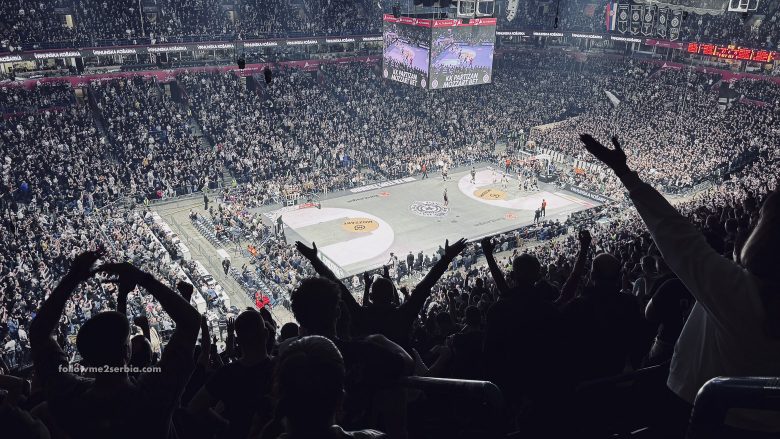
Even up on the upper tier (Nivo 400), people—including families with kids—often stand on their feet for the entire game, jumping, singing, and chanting. It’s incredibly atmospheric.
What to Do If Tickets Are Sold Out (Scalpers and Risks)
For marquee games against European heavyweights like Real Madrid, Barcelona, Panathinaikos (2023/24 champions), Fenerbahçe (2024/25 champions), Olympiacos (last season’s champions), as well as the Eternal Derby, tickets sell out within an hour. Truth be told, there are plenty of games I’d love to attend where I simply don’t manage to grab tickets in time.
Should you buy tickets from scalpers? On game day, scalpers (known locally in Serbian as tapkaroši) always loiter right outside the Arena. Buying tickets from them in person is a massive gamble. Most tickets nowadays are electronic, and the very same piece of paper with a printed QR code can easily be sold to ten unsuspecting tourists. Whoever scans their ticket at the turnstile first gets inside, while everyone else is left out in the cold, out of pocket.
A similar story happens in Facebook fan groups: scammers selling screenshots of someone else’s tickets are everywhere.
Options are limited. If you want to experience the Derby, you can join a small group tour led by a local Serbian guide (more details on this below). And if you can’t get your hands on Euroleague tickets, there’s always the regional ABA League (Adriatic League). Tickets for these games are cheaper and far easier to snag, though the crowd atmosphere at routine ABA League games is much more subdued.
Attending the Eternal Derby and Euroleague Games with a Local Guide
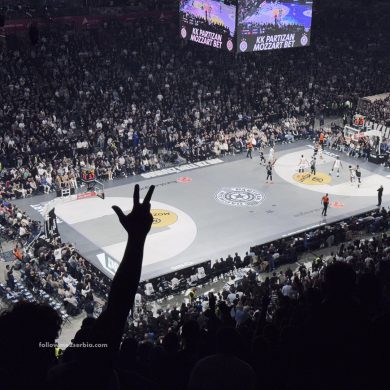 You can go to the derby with a Serbian local to make the experience much more fun and less daunting if it’s your first time. The guide secures the tickets in advance, meets you before the game, guides you through security, and translates fan chants throughout the match while explaining the historical rivalry and backstory. These tours are held in small intimate groups (up to 5 people), making the vibe genuinely friendly and comfortable. You can check the schedule for guided Euroleague experiences and book your spot on GetYourGuide via this link → (I highly recommend booking your derby spot well in advance).
Are Euroleague Games in Serbia Safe? Unwritten Rules of the Stands
To ensure maximum safety, gendarmerie (riot police) in full tactical gear are stationed at all matches. It might look intimidating at first glance, but in reality, I’ve never once attended a game where they had to disperse the crowd.
Strict security checks and body searches are carried out at the arena entrances; you aren’t allowed to bring prohibited items inside. I’ll cover the security screening process in detail below.
On top of all that, there is an unwritten dress code:
Never wear red to a Partizan game, and never wear black and white to a Crvena Zvezda game.
This applies to scarves, t-shirts, and any apparel linked to the clubs. That goes double if you’re attending a Partizan vs. Crvena Zvezda derby.
Can you bring kids to the games? Yes, Serbs regularly bring their children to basketball matches. The key is to buy tickets in one of the central seating zones rather than the ultra fan curves (as explained above). For younger children, parents usually bring dedicated noise-canceling earmuffs, because it gets exceptionally loud inside the arena.
Where EuroLeague Games Are Played in Belgrade: Logistics and Getting There
The vast majority of EuroLeague games are played at the country’s premier venue—Belgrade Arena (Beogradska Arena). However, clubs occasionally host matches at their backup venue: Aleksandar Nikolić Sports Hall, better known as Pionir. Here’s a breakdown of the differences between the two arenas and how to get to each.
Belgrade Arena (Beogradska Arena)
📍️️️️️️Location
Belgrade Arena is the largest indoor arena in the Balkans, holding over 20,000 spectators. It’s located in the Novi Beograd (New Belgrade) district. Getting here from Old Belgrade is very easy by bus (via Branko’s Bridge or the Gazela Bridge) or by taxi. If you’re coming in from another city for the game and wondering where to stay, I covered the best neighborhoods in this guide.

If you plan on driving, brace yourself for total traffic gridlock. The official parking lot and all surrounding courtyards physically cannot handle that many cars. An hour before tip-off, cars are abandoned on lawns, sidewalks, and traffic islands within a kilometer radius. You’ll either need to arrive two hours early to hunt for a spot, or simply take public transit or a taxi.
Make sure to arrive at the Arena at least 45 to 60 minutes before tip-off. You’ll need that time to find your entrance (the Arena has multiple gates—North, South, etc., so check your ticket), wait in line, clear multiple police checkpoints, scan your ticket, and navigate your way to your sector inside the massive concrete concourse. On top of that, if you arrive right at game time, you’ll miss the legendary pre-game chants and team anthems echoing across the stands.
Aleksandar Nikolić Sports Hall (Hala Pionir)
📍️️️️️️Location
Aleksandar Nikolić Sports Hall (or Hala Pionir) is located in the Palilula district, much closer to the historic city center, and holds only about 8,000 spectators.
The stands here are steep and hang right over the court, the acoustics amplify the roar tenfold, and fans in the front row can practically reach out and touch opposing players. Because of this enclosed cauldron design, the atmosphere becomes intensely hostile for visitors. EuroLeague fixtures are typically moved here only when the Arena is booked for concerts or tennis tournaments, but if you manage to snag a ticket for a game at Pionir, get ready for the most deafening sporting experience of your life.
Attending Basketball Games in Serbia: Rules and Practical Tips for Visitors
Here are a few essential tips straight from my personal experience:
- Arrive early! There’s always a line at the entrance. I once stood in the pouring rain for 45 minutes, and the game had already tipped off by the time I finally reached my seat.
- Security screening is very strict, especially for the Eternal Derby and high-profile matchups. Metal coins, lighters, umbrellas, plastic or glass bottles, and basically anything that could be thrown onto the hardwood are strictly prohibited. I’ve seen fans hurl anything within reach onto the court after controversial referee calls more times than I can count.
- A tip for the ladies: leave your makeup bag at home—security will confiscate even lipstick.
- Take public transport or a cab. Parking lots are completely packed both around the Arena and in the surrounding neighborhoods.
- Alcohol is not sold inside the Arena. You can buy water, Coke, non-alcoholic beer, and popcorn inside, but expect venue markups: popcorn is 300 RSD (2.55 €), and a small non-alcoholic Heineken is 600 RSD (5.10 €). Both cash and cards are accepted.
- No need to print your tickets. Showing them on your phone works just fine—the turnstiles only scan the QR code anyway.
And one final note: be prepared for a mind-boggling amount of Serbian swearing. Even kids and teenagers curse like sailors here—it’s practically an art form and a passionate part of the fan culture. Every single game, I find myself learning colorful new Serbian phrases.
Where to Buy Team Merch: Partizan and Crvena Zvezda Fan Shops
You’ll see street vendors selling team scarves right outside Belgrade Arena on game day. I can’t vouch for the official licensing or long-term quality, but they’re affordable, and I’ve even picked up a scarf this way myself.

However, if you want authentic, official merchandise or scarves, make sure to visit the official club fan shops in the city center or the authorized stalls inside the Arena itself. In my article on What to Bring Home from Serbia as a Souvenir, I shared the exact locations of the official fan shops for both Zvezda and Partizan.